
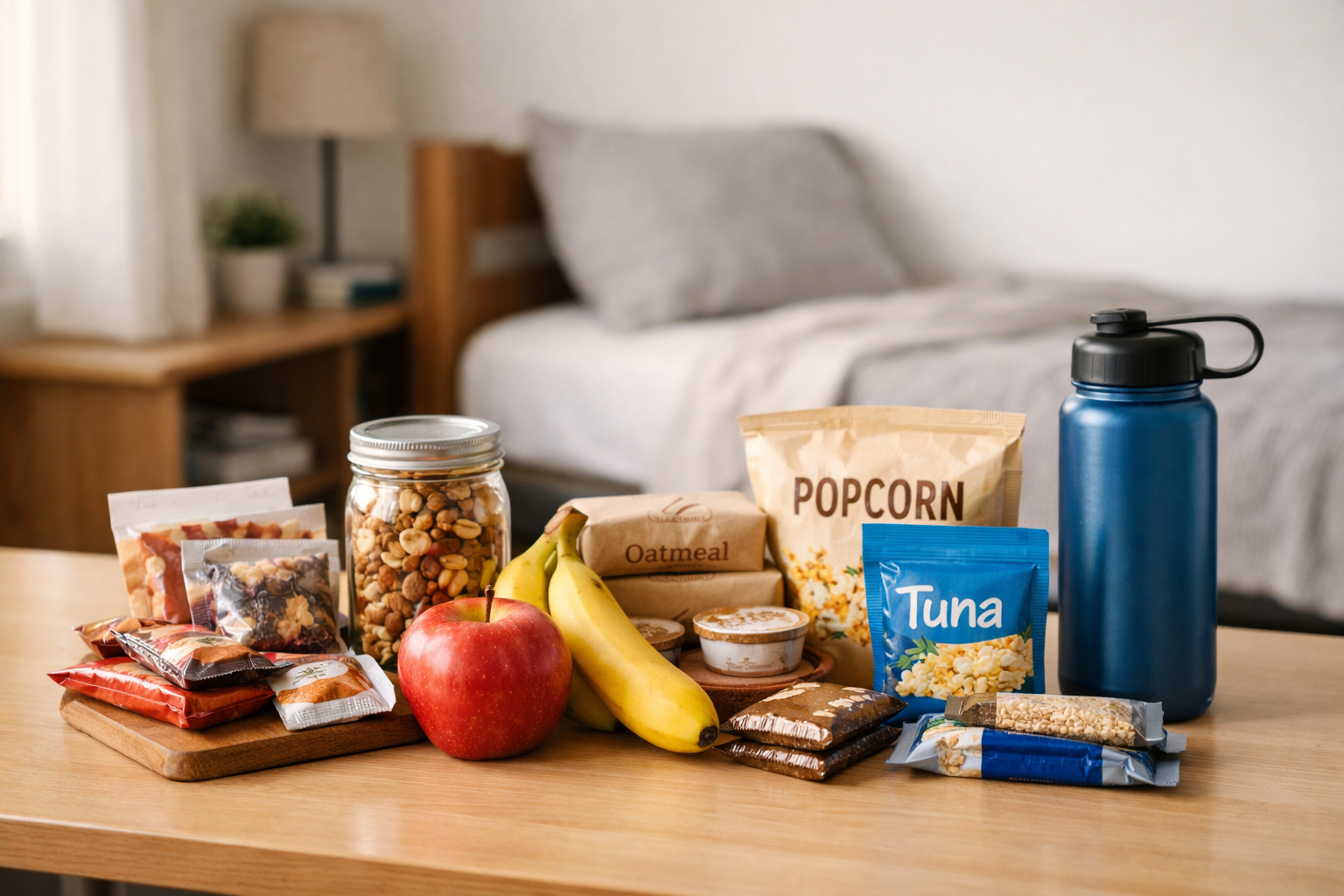
Making the switch from a fully stocked pantry at home to a dorm where you have to stock your own snacks can be a big change for some kids (I’m convinced my kids think food just appears in the house).
The good news is you can stock cheap healthy snacks for a dorm that feel normal, taste good, and work with a mini fridge and a microwave. Below is the system I’m planning to use, plus snack ideas with realistic dorm prep, a 7-day sample plan, and a grocery list that fits a $25 to $40 week.
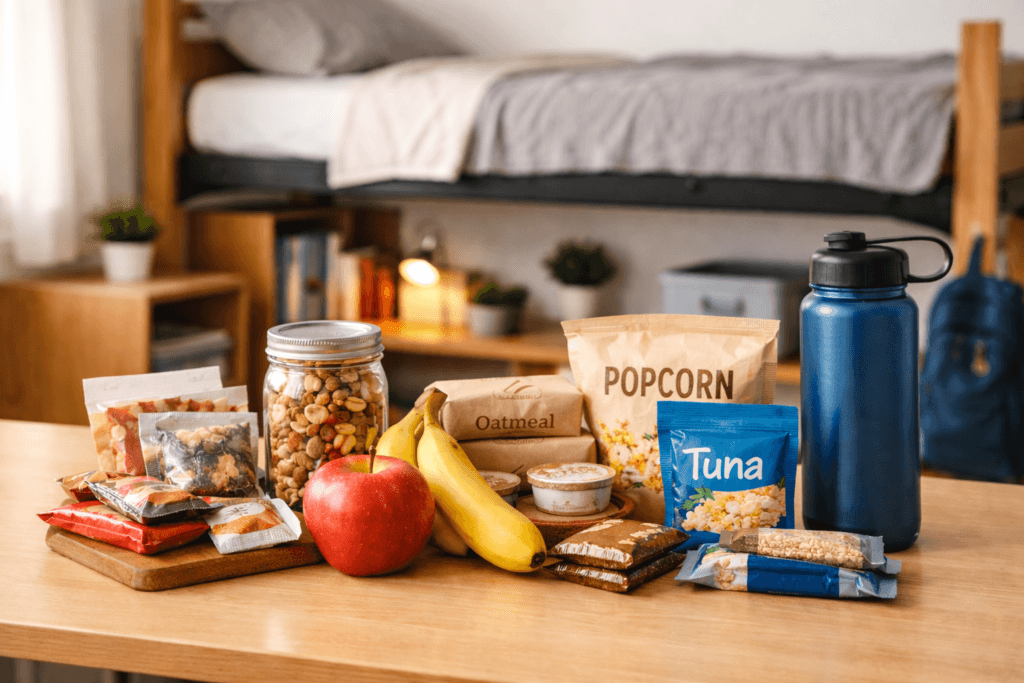
My no-kitchen dorm snack setup (the “grab-and-go” rule)
When I’m helping a student set up dorm food, I keep it simple: if it takes more than 2 minutes, it won’t happen on a busy day. So I plan snacks in two zones.
First is the shelf-stable zone (desk drawer, bin, or closet). Think: oats, nut butter, tuna packets, crackers, popcorn, fruit cups, and trail mix you portion yourself. These save money because they don’t spoil fast, and they cut down on last-minute vending machine runs.
Second is the mini-fridge zone (a small basket helps). I stick to items that are easy to eat, not “ingredients for a recipe” that no one will cook. Yogurt, cheese sticks, hummus, hard-boiled eggs, baby carrots, salsa, and pre-cooked chicken are the kind of foods that get eaten.
If you can add a few basics, the whole thing runs smoother:
- Microwave-safe bowl and plate (real ones, not flimsy)
- Spoon, fork, and a small knife
- Mini cutting board (even a thin plastic one)
- A couple of food containers (for leftovers or pre-portioned snacks)
- Electric kettle (optional, but great for oatmeal and soup)
That’s it. A dorm snack setup should feel like a convenience store you own.
Cheap healthy snacks for dorm life (24 ideas with dorm prep and cost)
Prices vary by store and city, so I’m sharing ranges per serving that usually hold up if you shop store brands and watch sales.
Here are my go-to cheap healthy snacks that don’t need a real kitchen:
| Snack idea | Dorm prep | Approx. cost per serving |
|---|---|---|
| Peanut butter banana “boats” | Split banana, spread PB | $0.35 to $0.80 |
| Apple slices + peanut butter | Slice, dip | $0.60 to $1.20 |
| Greek yogurt + frozen berries | Stir together | $0.90 to $1.60 |
| Cottage cheese + pineapple | Spoon and eat | $0.90 to $1.50 |
| String cheese + grapes | Grab both | $0.60 to $1.10 |
| Hummus + baby carrots | Dip | $0.70 to $1.30 |
| Hummus + pretzels | Dip | $0.50 to $1.00 |
| Tuna packet + whole-grain crackers | Mix, scoop | $1.10 to $2.00 |
| Chicken pouch + salsa | Stir, eat with chips | $1.30 to $2.40 |
| Hard-boiled eggs + pepper | Peel and eat | $0.50 to $1.20 |
| Microwave oatmeal + cinnamon | Add water, microwave | $0.30 to $0.70 |
| Oatmeal + banana slices | Top it | $0.50 to $1.00 |
| Instant miso soup + edamame | Microwave edamame, sip soup | $0.80 to $1.60 |
| Microwave steamed edamame | Steam bag, salt | $0.70 to $1.30 |
| Air-popped popcorn (microwave) | Pop, season | $0.25 to $0.60 |
| Trail mix (DIY) | Portion into bags | $0.50 to $1.20 |
| Roasted chickpeas (store-bought) | Grab bag | $0.80 to $1.50 |
| Whole-grain toast + nut butter (if toaster allowed) | Toast, spread | $0.40 to $0.90 |
| Rice cakes + nut butter | Spread | $0.35 to $0.90 |
| Rice cakes + hummus | Spread | $0.40 to $0.90 |
| Salsa + baked tortilla chips | Dip | $0.50 to $1.00 |
| Mini guacamole cups + crackers | Dip | $1.00 to $2.00 |
| Chocolate milk box + banana | Drink and eat | $0.90 to $1.70 |
| Dark chocolate square + almonds | Pair a little sweet with protein | $0.40 to $1.10 |
If you want more student-tested options that still feel snackable (not diet food), I like this roundup of healthy portable snacks for college students. It’s helpful when your teen gets bored of “mom snacks.”
A simple 7-day snack plan (plus a $25 to $40 grocery list)
The easiest way to keep snacks cheap is to repeat ingredients. I’d rather buy a bigger tub of yogurt than seven random “health” bars.
Here’s a sample week with two snacks per day. Swap days around based on class schedule.
| Day | Snack 1 | Snack 2 |
|---|---|---|
| Monday | Greek yogurt + berries | Popcorn + string cheese |
| Tuesday | Apple + peanut butter | Hummus + carrots |
| Wednesday | Oatmeal + banana | Tuna + crackers |
| Thursday | Cottage cheese + pineapple | Edamame |
| Friday | Trail mix (DIY portion) | Salsa + baked chips |
| Saturday | Hard-boiled eggs | Grapes + cheese stick |
| Sunday | Rice cakes + peanut butter | Dark chocolate + almonds |
This is the tight grocery list I’d buy for one student for a week (assuming they also eat some dining hall meals). It typically lands around $25 to $40, depending on brand and sales.
- Produce: bananas, apples, grapes (or any on-sale fruit), baby carrots, salsa
- Protein and dairy: Greek yogurt tub, cottage cheese, string cheese, hummus, eggs
- Pantry: oatmeal, rice cakes, whole-grain crackers, popcorn kernels or microwave popcorn, tuna packets
- Extras: almonds (or sunflower seeds), dark chocolate, frozen berries (often cheaper than fresh)
If your teen wants a little more structure (and fewer random purchases), this guide to dorm-friendly meal prep is a solid reference for keeping costs down without cooking much.
How I avoid “health halo” snacks, add protein, and keep food safe
The sneaky sugar traps I watch for
Some snacks look healthy because the package is beige and covered in words like “protein” or “made with whole grains.” Meanwhile, they’re basically candy with a yoga mat font.
I don’t ban these foods, but I do set a simple rule: if a snack has a lot of added sugar and not much protein, it won’t keep my kid full. Granola bars, flavored instant oatmeal packets, bottled smoothies, and sweetened yogurt are the usual suspects.
My quick test: I want a snack to have some protein or fiber, and I don’t want sugar to be the main event.
If your teen wants sweet, I’d rather pair it with something steady, like fruit plus nut butter, or yogurt plus berries.
Easy allergy swaps and higher-protein upgrades
Most dorm snacks can flex without a full redo:
If nuts are an issue, I swap peanut butter for sunflower seed butter, and almonds for roasted pumpkin seeds. For dairy-free students, shelf-stable protein shakes and soy yogurt help, and hummus becomes even more useful. If gluten is the problem, rice cakes and corn tortillas replace crackers.
To bump protein without turning snacks into “gym food,” I add one of these: a cheese stick, a tuna pouch, a yogurt cup, edamame, or a hard-boiled egg. It’s the same snack, just sturdier.
Mini-fridge storage that prevents the gross surprises
Mini fridges run warm, especially when roommates keep opening them. I aim to keep it cold enough for dairy and eggs, and I don’t play games with food that spoils fast.
I also use a few habits that save both money and stomachaches: keep perishable snacks on the middle shelf (not the door), wipe spills right away, and date leftovers with a marker. If something sat out during a long study session, I toss it. No one needs a “brave” yogurt.
For more dorm-friendly snack combinations that don’t require cooking, I’ve also pulled ideas from easy healthy college dorm room snack recipes, then simplified them into “two-ingredient” versions.
Dorm snacking doesn’t have to mean chips for dinner. With a small system and a repeatable grocery list, cheap healthy snacks become the easy choice, not the extra effort. I’d start by picking 10 snack staples your teen will actually eat, then build a week around them. After all, the best dorm snack is the one that’s there when hunger hits. What would your kid grab first, something sweet, something salty, or something with crunch?